
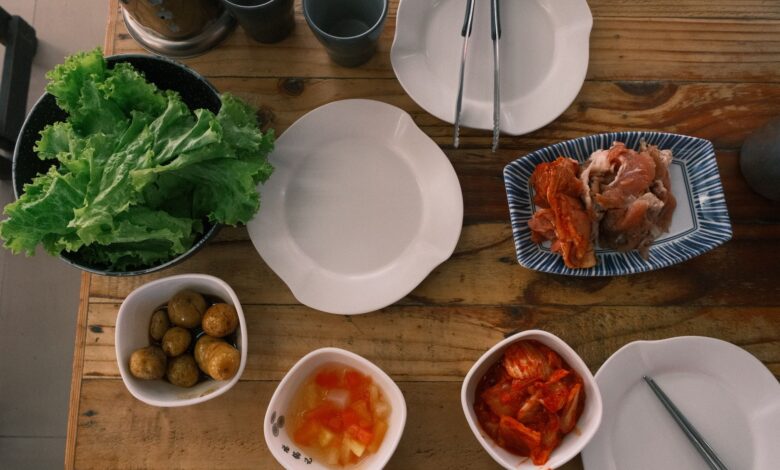
Three Japanese habits stop working the moment you sit down at a Korean table: lifting the rice bowl, letting chopsticks do all the work, and waiting to be bowed at rather than bowing first. In Korea the bowl stays down, the spoon owns the rice and the soup, and a visitor is expected to offer the greeting. Seoul’s city tourism body and the Republic of Korea’s own government site both publish those rules, and they agree on all three.
What they do not spell out is the part that actually trips people up. Almost every Korean courtesy rule is a function of who is sitting across from you: bow depth, which hand carries the glass, who lifts a spoon first. Seoul’s own guidance puts it plainly — the meal starts once the eldest at the table begins. Get that one variable right and the rest stops feeling like a list to memorise.
Why Rank, Not the Rulebook, Decides Korean Etiquette
Almost every rule below changes value depending on who is present, and all of them were checked against the sources named here on 20 September 2026 — the one legal item in this article is set by the Korean government and can change, so confirm the current position on Korea’s own government site before relying on it for anything official.
Seoul’s visitor guidance describes Korean culture as deeply rooted in family values, respect and obedience toward people regarded as having higher status, rank or age — parents, teachers, older siblings, older colleagues. Then it adds the half nobody quotes: those same senior people carry more responsibility and obligation toward their juniors. Courtesy here runs in two directions. It is a relationship, not a ladder.
Which is why a single year of difference carries weight. When you meet someone new in Korea, the immediate question is less about politeness than about grammar, because Korean changes shape according to the relationship between two speakers and needs your relative position before a sentence can be finished. “The number one factor when determining which speech style to use is age,” Jieun Kiaer, professor of Korean language and linguistics at the University of Oxford, told a BBC Travel feature on the subject. Her point about why the question arrives so fast is the useful one: people are not curious about your birth year, they need it to choose a form of address.
So answer it and move on. Names follow the same logic, and the city’s guidance is blunt about them — never address a Korean by their given name unless you have been invited to, use a professional title with the family name for people of similar rank, and use the title alone for anyone senior. Introducing yourself at a gathering is also weaker form than being introduced by someone else.
The one genuinely legal item here is a counting rule, and it is worth knowing before someone asks your age. Full-year age counting — the international method, starting at zero and adding a year each birthday — became the required way to calculate age in legal and public documents and contracts in the Republic of Korea from 28 June 2023. That date comes from Korea.net, the state’s own news service, reporting the Ministry of Government Legislation’s announcement. The shift made every Korean a year or two younger than their “Korean age.”
Four carve-outs survived it, and they are the ones a visitor can actually bump into. The same official report sets out that the new counting does not apply to elementary school entry, the draft, purchases of tobacco or alcohol under juvenile protection laws, or civil service exams, all of which still count by birth year. The older arithmetic was narrowed to specific purposes rather than abolished outright. That is an administrative matter, checked against the Korean government’s own publication on 20 September 2026, and nothing else in this article describes a custom you could be fined for.
What follows from all this is a habit rather than a fact. Before you speak in a room with an elder, work out who holds the higher position — age first, then professional rank — and let the answer set your hands, your tone and your timing. When you can’t tell, formal speech and a slightly deeper bow cost nothing and offend nobody. The reverse also holds: with someone clearly junior to you, stiff formality reads as distance rather than respect.
What You Carry From Japan and What You Have to Leave at the Border
Japan and Korea are not one culture with two alphabets, and the etiquette overlap is smaller than the map suggests. What they genuinely share is rank. Japan’s Ministry of Agriculture, Forestry and Fisheries, in a dining-etiquette exhibit produced with the etiquette instructors of a Tokyo ryotei, states that people commonly serve alcohol to their fellow diners rather than pouring for themselves, and that a hierarchy runs through it: you stay attentive to anyone of higher status. If you learned to watch a senior colleague’s glass in Tokyo, that habit works in Seoul.
The difference is what the attentiveness is attached to. Korea builds rank into the order of the actions themselves — who initiates the bow, who offers the hand, who lifts a spoon first, who takes the first sip, who leaves first — so a careful visitor who stays passive can still mistime a step. Japan expects less performance from a guest. Its national tourism organisation tells visitors on its customs and manners page that they are “more likely to be bowed at, rather than expected to bow,” and closes by telling them to simply ask when they are unsure.
The physical kit gives the switch away before any social rule does. A traveller who did Seoul and Busan in September 2025 before crossing to Hiroshima, Kyoto and Tokyo wrote on A Milian Adventures that Korean restaurants kept the cutlery in a little drawer in the table and that staff always pointed it out — “I could see being confused if they hadn’t” — and noticed the chopsticks themselves changing from metal in Korea to wood in Japan. That account covers a few large cities on one trip and the writer says so plainly, but it puts the carry-over problem in the right place: you notice the equipment first, and the rule second.
Read the table one row at a time. The Korea column tells you what to do; the Japan column is there to catch the reflex you are about to run instead.
| Habit | In Korea | In Japan | What to switch at the border |
|---|---|---|---|
| The rice bowl | Kept on the table in Korea; lifting your soup or rice dish while eating is named as something not to do | Holding the dish in the hand is presented by Japan’s agriculture ministry as Japan’s own practice, with the soup bowl raised and drunk from two-handed | Stop lifting. Leave the bowl where it was put. |
| Utensils | A spoon for rice and soup, chopsticks for side dishes and meat; in Korea the set often lives in a drawer in the table | The ministry exhibit describes drinking the soup straight from the bowl and using chopsticks for the ingredients in it | Reach for the spoon. This is the most visible slip a Japan-trained visitor makes. |
| Chopsticks upright in rice | Never in Korea — the gesture belongs to rituals for the dead | Also avoided in Japan | Nothing to change. This habit travels intact. |
| Pouring and drinking | Never pour your own in Korea; the senior’s glass first, both hands, and the junior turns their head away to drink | Japan’s ministry exhibit describes diners serving each other rather than themselves, with attention going to higher status | Keep the pouring habit. Add the turned face, which is the Korean part. |
| Tipping | Not customary in Korea; some people may receive it, some may refuse it | Not common in Japan for bars, cafés, restaurants, taxis or hotels | Leave it alone in both. Pay the amount shown and don’t press a note on anyone. |
| Your voice in public | Keep it down in Korea, including on the phone, with music audible only to you | Phones on silent in Japan, calls avoided on public transport | Nothing to change. Both reward quiet. |
One of those rows matters more than the rest, and it isn’t the bowl. If you carry a single correction across the border, carry the spoon. Visitors trained in Japan reach for chopsticks by default and keep using them for everything, which in Korea means eating rice with the wrong tool in front of people who notice and won’t say so. It takes one meal to fix.
How to Greet Someone in Korea: The Bow, the Handshake and the Two Hands
The bow is the greeting, and its depth is relative rather than measured. Seoul’s tourism authority describes everyday greeting bows as possibly no more than a slight bob, with one governing rule: the elder the recipient, or the higher their status, the deeper the bow — made from the waist, legs straight, hands at your sides. The precise angle figures circulating in travel guides, fifteen degrees here and forty-five there, appear nowhere in the city’s guidance or in the national government’s material. Treat any degree number you read as somebody’s invention. Depth tracks the person in front of you, and that is the whole instruction.
Where visitors most often misfire is the handshake that sometimes follows. The city’s guidance notes that men often follow a bow with a handshake, and that your right hand should be supported by your left as you shake. That detail is the whole system made visible: you are steadying your own hand because the other person outranks you. Offer your hand only after theirs appears, and if they simply nod, a nod back is a complete exchange.
Then there is the two-hands rule, which has nothing to do with bowing and everything to do with objects. Seoul’s guidance puts it as flatly as it can be put: give and receive any object using both hands. Money, a card, a receipt, a gift, a business card, a glass — the rule draws no distinction between them, and the everyday version is easier than it sounds, with one hand on the item and the other supporting your forearm.
Two details that no official source covers are worth having anyway, as long as you know where they come from. An independent Korean culture site, Knowing Korea, which carries no state attribution, notes that a silent bow given without any verbal greeting can read as rude, and that when two people part, the junior waits for the older or higher-positioned person to lead the departure. Both are easy to act on. Say hello as you bow, and let the other person move first when you leave.
Five moves cover almost every greeting you will make. Run through them once before you fly and they stop being decisions.
- Establish who is senior. Age first, then professional rank. Everything below depends on this answer.
- Bow from the waist, legs straight, hands at your sides, with the depth answering to that person’s seniority. A slight bob is a real bow.
- Say something while you do it. “Annyeonghaseyo” for hello or “bangapseumnida” for nice to meet you — enough to keep the bow from reading as empty.
- Take the hand only if it is offered, with your right hand supported by your left. If no hand appears, don’t reach for one.
- Use both hands for whatever comes next — cash, a card, a receipt, a bag. One hand on the object, the other on your forearm.
The romanised phrases the city publishes are the ones worth having ready before you land: “gamsahamnida” for thank you and “sillyehamnida” for excuse me will carry most of a day. The city’s own pronunciation note helps more than it sounds like it should — round the vowels out as though there were a soft “h” inside them, and stay formal at first whatever the situation looks like.
Korean Table Manners: The Rice Bowl Stays Down, the Spoon Owns the Rice
Two rules organise a Korean table, and both are about restraint: the bowl stays where it was put, and the cutlery divides the work. Seoul’s tourism authority states the first plainly — the rice bowl is usually left on the table — and the Republic of Korea’s own table-manners guidance goes further, listing lifting your soup or rice dish while eating alongside sticking chopsticks in a bowl of rice as things not to do. Arriving from Japan, where raising the bowl is ordinary and the soup bowl is drunk from two-handed, this is the habit that has to be unlearned rather than adjusted.
The cutlery split is a division of labour, not a preference. Rice and soup belong to the spoon; side dishes and meat belong to the chopsticks. The setting itself tells you which is which, because the same official guidance describes a fixed layout: rice on the left and soup on the right, spoon on the left and chopsticks on the right. A Korean set meal also arrives all at once rather than in courses, so the whole arrangement is in front of you from the first minute.
Everything on that table is shared except your own rice and your own soup. Stews, meat and the row of side dishes sit in the middle for everyone to reach into, which is why loading a large portion onto your own plate reads as a misunderstanding rather than as appetite. Seoul’s guidance also asks diners not to pick through the dishes hunting for the best pieces. Take a little, eat it, go back. Nobody is competing with you.
The funeral gesture is the one mistake whose cost is different in kind. The state’s own article ties the prohibition directly to its meaning: chopsticks standing upright in a bowl of rice is what is done in rituals for the dead. It pairs that with a second instruction — don’t leave the chopsticks in the rice bowl when you finish — and Seoul’s guidance gives the positive version, which is to return the chopsticks and spoon to their original position at the end of the meal. Mid-meal, the safe habit is to keep them together on the table or on a rest if one is provided.
Then there is the eldest, and a rule that is taught more absolutely than it is practised. Seoul’s guidance says you start once the eldest at the table begins eating; the state’s article describes younger people not picking up their utensils until the older people do. Neither source describes how often the rule gets waived from the other side.
That is where a long-term resident writing at The Soul of Seoul is more useful than either. In her account the oldest person frequently tells everyone to go right ahead and dig in, so the workable version is to wait until that person either starts eating or says something. Her note on the bowl matches the careful wording of the official rule, too — among close friends finishing a good soup, lifting the bowl for the last of the broth is more forgivable, and the instruction she gives after it is to read the room.
Korean Drinking Etiquette: The Two-Handed Pour and the Turned Face
The round is a sequence, and it is where an otherwise careful visitor makes the one error that is visible across a whole table. The basic instruction is counter-intuitive for anyone used to ordering their own drink: never pour your own. Seoul’s tourism authority states it directly — let someone else pour for you — and sets the order of business, which is that if you are drinking with someone more senior, their glass is filled first. An empty glass in front of you calls for patience, not the bottle.
The two-hands rule applies here, and the sources do not entirely agree on its physical form. Seoul’s guidance says to hold the bottle or glass with two hands both when pouring and when receiving. The state’s table-manners article says the same in the same terms: hold the cup or the bottle with both hands when pouring for someone older, or when receiving from them.
What neither settles is whether both hands literally grip the vessel. The resident account quoted earlier describes the everyday form as one hand on the bottle or glass with the other resting on your forearm, reserving a genuine two-handed grip for showing very high respect, and a Seoul food-tour guide writing for visitors describes the same forearm-supported version.
The likely reason for the gap is that an official page writes a rule at its most formal while practitioners describe what people actually do. Both forms read as deliberate. What gets noticed is a bare one-handed pour with nothing supporting it.
Then the turn, which is the part with no Japanese counterpart. Seoul’s guidance says that if you are the junior, good manners means turning your head to the side, away from your senior, as you drink. The state’s article describes the same act as turning slightly away. With older people on both sides of you the movement is small; it is about the direction of your attention rather than about hiding your face.
Sip order mirrors the first bite. The most senior person drinks first and everyone else waits for that. When the hierarchy at a table isn’t obvious to you, the practical move is to hold your glass through one round, watch, then join at the pace the table has already set.
Self-pouring is the exception that carries a trap in it. The same resident account notes that people do pour for themselves in casual groups, and that a visitor should not be the one to start it at a table with seniors present. Her own lasting mistake came from exactly that confusion — she copied a gesture she had watched her husband’s friends use among themselves, tried it on her father-in-law, and was met with visible shock. The same movement carries a different meaning at a different table. If the most senior person present pours their own drink, that is not an invitation to follow.
None of this makes drinking compulsory. Declining a pour is accepted without argument and you are not obliged to drink to be part of the round. What the etiquette does ask is that you hold the glass properly when something is poured for you, that you let someone else do the pouring, and that you turn slightly away from an elder when you drink.
Public Places: Low Voices, Two Hands and Where Shoes Come Off
Off the table, the rules are about volume, hands and thresholds — and this is the layer where Korea and Japan overlap most. Seoul’s tourism guidance asks you to keep your voice down in public, especially when speaking your own language, to moderate your volume on the phone, and to keep your music audible only to you. The same page notes that public displays of affection tend to be frowned on and kissing in particular is a no-go, and that physical contact with people you don’t know well is avoided — with the honest caveat that on a crowded subway some contact is unavoidable. Blowing your nose in public is singled out. So is pointing: use your whole hand instead.
Shoes come off at specific thresholds rather than everywhere. Seoul’s guidance is precise about which ones: any residence, temple or guesthouse at the door, plus Buddhist temple buildings, Korean inns, and restaurants where diners sit cross-legged at low tables. It also records that the shoes-off rule was once universal in all buildings, private and public, and no longer is.
That is why the reliable test is architectural rather than cultural. Look for the step up, the shoe rack, or the row of shoes at the door — a raised floor with cushions on it is a shoe-free floor. Japan has thresholds of its own, and this article does not attempt to state them, because no Japanese authority was consulted for that specific rule.
Paying is where a small reflex is worth leaving behind, and where the official wording is gentler than the folklore. The city’s visitor guidance says tipping is not customary in Korea, that some people may receive it while others refuse, and that the sensible response is to go with the flow. Pay what is shown and don’t add to it. The reasoning is not that a tip would insult anybody but that it isn’t a local habit, so it mainly creates confusion about what the money is for.
Japan’s position is similar. Its national tourism organisation’s tipping guidance says tipping is not common there for bars, cafés, restaurants, taxis or hotels, with one narrow exception: a private guide or interpreter may accept a discreet gratuity, customarily handed over in an envelope.
The counter is also the second home of the two-hands rule. Give and receive with both hands, one supporting the other, and a gesture that started as a bow at the door runs through the rest of the day without further thought. Two phrases from the city’s own published list carry most of the weight there: “sillyehamnida” for excuse me, and “eolmayeyo” for how much is it.
Two things widely repeated about Korean public life are deliberately left out of this section. The claim that everyone stands on one specific side of an escalator, and the related claim that eating or drinking on public transport is prohibited, are both carried by travel content and stated by neither the city’s nor the state’s published visitor guidance.
What those sources do state is quieter and easier to act on. Keep your voice and your phone down, keep your music to yourself, let people off before you get on, and leave the seats to the passengers who need them. Japan expresses the same layer as phones on silent and calls avoided on public transport, so this is the part of the trip that changes least when you cross.
Home, Temple, Market Stall, Business Dinner: How Much a Rule Tightens
The most useful thing to know about every rule above is that its strictness moves. The Republic of Korea’s own table-manners article opens with exactly that reassurance, telling readers not to worry too much about formality because many households eat quite casually. These rules are the default, and a default is not a constant. Seoul’s guidance separately notes that most Koreans understand a foreigner’s minor social slip is not meant as disrespect, and its own etiquette page adds that visitors are generally given a pass on missteps made out of ignorance rather than malice. Take the rules seriously; take the enforcement calmly.
Strictness tracks three things, and once you can see them you can read a room in about thirty seconds.
The first is the formality of the setting. A family table is relaxed; a temple or a formal traditional setting is not. The resident writer quoted earlier describes being told during a templestay programme to make no noise at all while eating — no talking, no clinking of utensils against bowls — and describes dinners with friends and colleagues as a completely different occasion, where the conversation is the point.
The second is who is present: a meal among people your own age, with no senior at the table, asks very little of you. The third is who invited you, because as someone’s guest, what is actually being read is your attentiveness rather than your accuracy.
That gives you a check you can run instead of memorising anything. Before your first mouthful or your first pour, look for the three signals in order — how formal the room is, whether anyone at the table clearly outranks the others, and whether you are a guest or just a customer. Then match whatever the table does. A market bench at lunchtime and a business dinner in the same city are different rooms with the same rules set to different strengths.
The strongest instruction available for all of it is the one both countries publish about themselves. Japan’s national tourism organisation tells visitors that if in doubt they should follow the locals, and that people will be happy to explain a custom if asked. Seoul’s guidance works from the same premise in the other direction: the visitor is welcome to try rather than required to be correct. A question asked at the table beats a confident mistake in both countries, and it is the only repair that works on a rule you didn’t know existed.
One last thing about the sources, because a rule you can check outlives an article you have read. Everything above comes from four places you can open yourself: two Visit Seoul pages published by the city’s tourism organisation, two Korea.net articles published by the Republic of Korea, and, on the Japanese side, the national tourism organisation and the agriculture ministry’s own dining exhibit. Custom moves slowly, but the two Korean city pages carry edit dates from 2019 and 2020, so if a detail here matters to your trip, go and read what those pages say now rather than trusting the version of them that reached you second-hand.
The Mistake That Costs the Most
The most expensive mistake in Korea is not a gesture at all — it is assuming that Korean etiquette is a fixed list rather than a sequence keyed to whoever is sitting with you. The action that follows is small and works everywhere: before you bow, eat or drink, spend one round watching who the room defers to, then take your timing from that person. Do it, and the bowl, the spoon and the pour arrange themselves around you. Skip it, and you will run a Japanese sequence in a Korean room while everyone quietly gives you the pass that Seoul’s own guidance says you’ll get.
Frequently asked questions
Is it rude to hold your chopsticks and spoon at the same time in Korea?
Seoul’s guidance and the Korean government’s own article both assign rice and soup to the spoon and side dishes to the chopsticks, but neither states a rule against holding both. Several community guides do state one. Using one utensil at a time costs nothing, so default to that.
Should you bow back when a shop assistant bows to you?
A short bow — essentially a nod — is what Seoul’s visitor guidance describes for everyday greetings in Korea, and returning one costs nothing. Since depth tracks age and status, a nod is a complete exchange with a stranger at a counter.
Do you tip a tour guide in South Korea?
Seoul’s guidance says tipping is not customary in Korea and that some people may receive it while others refuse, so there is no expected amount for a guide. Japan’s tourism body is more specific for its own country, noting a private guide or interpreter may accept a discreet gratuity, customarily in an envelope.
